Translate

Showing posts with label brooklyn. Show all posts

Tuesday, April 23, 2013

Want to Get Started with Low Start-Up Money? You need an Incubator Kitchen


Interview with Michasel Hu
Pastry Chef/Owner Hana Enterprises

With Jessie Riley, Jeff Yoskowitz and Alan Someck

(Editor’s note: Michael Hu, acclaimed Pastry Chef, is owner of a wholesale pastry business and an incubator kitchen)


Jessie:  Hi Michael; since I worked with you here about 6 years ago, you’ve really expanded your space here in Sunset Park, Brooklyn.

Michael:  We now have 12,000 square feet total space.  I actually expanded after the economic downturn because my own wholesale clients weren’t ordering as much product.  People who had lost their jobs wanted to start their own food businesses.  But not all entrepreneurs have the business financing they hope for to fulfill their dream.

My open commercial kitchens were the perfect match for entrepreneurs to rent.   We’re open 24 hours a day for 3 production shifts a day. It’s fully equipped, offers office space, laundry and cold storage. Parking is possible and it is near the subway. 

Jeff:  How do clients find you?

Michael:  We have an open house the first Saturday of each month (10 am – 2 pm).  Everyone is welcome!

Section of Hana Enterprises Checklist for Incubator Clients

Alan:  How many kitchens do you operate?

Michael:  Currently we have 10 kitchens here.  Not all are operated for pastry – it ranges from candy to BBQ, mac and cheese to macarons, sausages to granola, and organic dog food to ice cream. 

Jeff:  So you have USDA oversight?

Michael:  Yes. We email the production schedule to the USDA inspector, so they can choose whether to be onsite or not. 

 
Chef Michael with the production schedule

Jessie:  Are you still doing some of your own production here?

Michael:  Yes, I am still producing and selling kosher pastries.

Jessie:  How do you juggle your own production and that of all your clients?

Michael:  We have a central scheduling system.  In fact, I have staff that runs all the centralized machinery for everyone, and it is also inspected after each use.  For example, we have direct wired the Hobart mixers so they have to be turned on by my staff – not people renting the kitchen. That ensures it is all fully operational and maintained for everyone.  

Some of Hana's Hobart Mixers

Alan:  Kathryn knows you from 1995 and we know you were the Executive Pastry Chef at the Waldorf-Astoria, have competed internationally and you have been named Top Ten Pastry Chef of the year.  Having that experience for an entrepreneur to draw on, what else distinguishes Hana from other incubator kitchens?

Michael:  Our management staff is quite experienced in the food field and are valuable resources for anyone starting or growing a food business.  We are also an approved vendor for Birch Street, which makes it possible for you to sell your product to all Hyatt and Marriott hotels. 

 Birch Street vendor

Jessie:  How do you decide what products you will back up for distribution through Birch Street?

Michael:  It has to be made with really great ingredients and it has to taste really good, and I have to believe it will be sustainable at a higher production level.

Jeff:  You have supported some very successful start-ups here; what do you see as the key signs if a food entrepreneur will succeed, or not?

Michael:  Assuming they have a good product, it is hard to find the right sales margins.  Then when they are able to optimize that, they need to streamline their production.  Some just increase production of product without optimization – and eventually that stunts growth.

Alan:  What outlets do your clients sell through?

Michael:  80% of my tenants sell in farm markets, and/or wholesale to stores.  Direct sales have a higher profit margin than going through distributors.  Incubator clients typically do not have the funds for building a brick and mortar location.
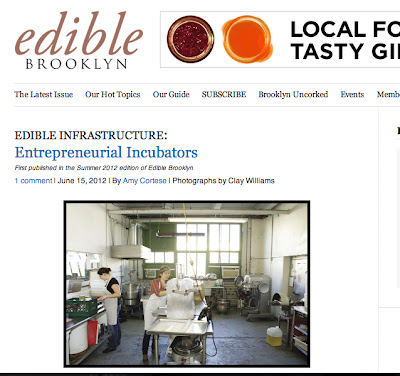
 Edible Brooklyn's picture of a production kitchen at Hana

Alan:  Is the incubator commercial kitchen here to stay? 

Michael:  We have good tenancy here now; I believe there is strong demand for incubator resources now, given the number of people who want to be entrepreneurs.  I’ve actually been looking at opening another location in the Bronx. 

Alan:  What’s next for you with Hana Enterprises?

Michael:  I want to attract bread bakers.  I see a need for a “central oven,” like when people years ago made their own dough and brought it to the baker to bake.  Except this could be for multiple artisan bread manufacturers, not just individuals. I would like that to be a center point where one day I can open my facilities to also become markets where the incubator clients can easily sell their products.

Alan: That sounds great Michael We’re really impressed with what you’ve done here.

Friday, August 31, 2012

Getting the Scoop: Brooklyn's artisan ice cream success


Do Your Research

Interview with Brian and Jackie Smith
Owners of Ample Hills Creamery, Brooklyn
By Jeff Yoskowitz and Kathryn Gordon


Jeff:  Hi Brian, Hi Jackie.  What is your concept and where did you get your concept from?

Brian:  My background is in creative writing.  I was a TV movie screen writer and directed audio plays.  I was always in the creative and entertainment world, and always had a love of ice cream.  I wanted to find something that was a little more community based than writing, and to do something that was more than the ice cream – I wanted to create a “gathering spot.”

From Ample Hills' website


Kathryn:  I first visited Ample Hills back on a cold night in winter, and there were a lot of people in here enjoying the ice cream, and also hanging out!

Brian:   I went to every ice cream shop in Manhattan and Brooklyn with my then 2-year old and researched ice cream shops in all 5 boroughs, looking at ways we could be different and have a competitive advantage.  We have created a space that appeals to people year round.  

I heard once:  “Any idiot can sell ice cream in the summer time, but what else are you going to do the rest of the year?”  If you can build a space that people want to be in, you can make a living during the other 8 months of the year.  

So many shops are small and you just get ice cream and leave. We wanted to build a children’s play area, so when it was dark in the middle of January they could go some place and get out of their house.  The concept was to do artisanal, made from scratch ice cream that didn’t have any pretentions from the foodie world.  We offer fun, funky, playful, rotating, changing flavors.  People get excited about that!

Ample Hills' Play Area 

 Jeff:  You are pasteurizing your own ice cream bases?

Brian:  In my competitive analysis, I learned that the vast majority of companies don’t pasteurize their bases, and use an ice cream mix.  For me, there was never a question of not pasteurizing, because for me and my creative background I knew it would become too boring if I just started from a mix.  I needed the challenge and complication of the fun of pasteurizing, and our ice cream tastes better because it’s fresher.

Kathryn:  You’re using local purveyors and farmers? 

Brian:  We source our milk, cream and eggs from different farms.  It has changed over time because our production volume exceeds the level some farms can provide us in terms of ingredients.  It’s a combination of what we can get, and who has enough milk for us. 

Jeff:  So you’re getting very fresh dairy products, producing small batches, and pasteurizing yourself. Cost wise, how’s it working out?

Brian:  Clearly, we probably make some of the most expensive ice cream in the city in terms of its food cost.   But we’re making up the lower profit margin in terms of volume.  We ran out of ice cream when we opened and had to close down for 9 days to restock. 

The authenticity of the experience drives our volume.  Customers waiting in line for their cone and seeing the ice cream being made (with the explanation boards of the process).  


View into the ice cream production kitchen

Jeff:  What are your food costs like?

Brian:  When I was doing my market research, I learned that food costs (of a sustainable business) should be between 25-28% and overall ours are okay. I have to trade off the cost of some of the more expensive ingredient flavors versus the less expensive.  Over time our purchasing power has gotten better, and we’ve been able to keep the ratio because we’ve been able to lower our base food costs.

Kathryn:  You have a general manager in charge of the front of the house and your wife Jackie does the books and payroll.  Are you doing the production?

Brian:  I was doing everything at first.  We’ve now been open a year and 2 months, and I’m trying to move in the direction that 2-3 people run the pasteurizer, and do the baking.   I’m still the only one churning and doing the mix-ins.

All the staff and customers help to create flavors.  I’m the final arbiter, but we have fan contests on Facebook and involve our community. 

Kathryn:  You’ve gotten a lot of initial favorable press, right?

Brian:  It’s all just come to us, because what we were doing was unique and different.  I now use social media, but a lot of our publicity came to us in our first four days of opening.  I didn’t plan it, but we ran out of ice cream.  Florence Fabricant at the New York Times covered us and we had a line around the block and we didn’t have any product.  We had to shut down.

I believe that we have “earned our press,” and “earned the lines” of people waiting for the ice cream.  I am passionate and did my research, planning our concept.  We make product from scratch, on location and that allows us creative freedom. 


Jeff:  What’s next for you at Ample Hills?

Brian:  We are looking at opening an additional retail space in Brooklyn with a production factory twice this size.  We’d still like to be a destination spot, but be able to offer ice cream classes, ice cream camp…

Kathryn:  You already offer a lot to your community through this location; I noticed your fun “Swap O Matic” machine here on my first visit.  And you have birthday parties here for kids? 

Jackie Smith in the retail shop

Jackie:  We have parties here every weekend!  We custom created a unique “ice cream churning bicycle” that kids enjoy using in their parties.  Our general manager also runs kid drawing contests and ice cream flavor/name contests on Twitter and Facebook.

Kathryn:  All the “community space” takes away from your production kitchen and I guess you’ve outgrown it?

Brian:  It’s hard to decide how large the production room was going to be, within a 900 square foot facility. I had to make the kitchen as small as possible – but it’s impossible to research ahead of time what you will ultimately need regarding space allocation.   But producing a higher volume of ice cream than I initially anticipated meant that in the first 9 days, I had to double the kitchen space we had allocated, buy larger blast freezers and a larger pasteurizer than I had initially purchased.

Jeff:  What warnings would you give other entrepreneurs?

Brian:  Be more prepared for success!  Like what am I going to do if I have 3 times the number of people buying ice cream than I had planned for?  I had prepared psychologically for the opposite, but we did run out of ice cream.  Interestingly, that generated more press than it might have if we hadn’t had to close down right after we opened.
 
Jackie:  Also, everything always costs more than you’d think.  With such constant use, this is our second set of guest tables.  We wind up painting every month the front of the ice cream case (because we couldn’t afford tiles when we first installed the case).  Luckily, our landlord lives above and he is also our general contractor, so we can get things fixed pretty quickly.

Brian:  Get as long a lease as you can.  I can’t believe entrepreneurs who are willing to settle on 3-5 year leases.  You create all this “energy,” around your brand – it may not be transferable to another location if you lose your lease.  So I wouldn’t put time, money and ambition into anything less than a 10-year lease, or you might wind up paying twice.


Want to Learn More About Our Services? Visit us and learn more at