Translate

Showing posts with label business financing. Show all posts

Sunday, April 28, 2013

Food Festivals and Weddings = Profits


 Interview with JulianPlyter
Co Owner/Chef of Melt Bakery

Interview by Kathryn Gordon


Kathryn:  Hi Julian!  I’d wanted to come and visit you at Melt Bakery ever since you were a guest panelist at one of our How to Start a Successful Bakery-Related Business at ICE (Institute of Culinary Education); and I absolutely love ice cream…

Julian:  And cookies. I really enjoy baking the cookies! 


Kathryn:  It’s very “neighborhood” here.  Already 3 guys have come in for ice cream sandwiches, and one has already come back for another one of the “sandwiches of the day.”

Julian:  We opened in this retail (brick and mortar) location in 2012 after 2 years of being in markets. The majority of our customers here do live or work in the neighborhood.  At our second permanent location, on the High Line, sales are more tourists driven. 

Kathryn:  Are all of your sales retail?

Julian:  We’re also in about 20 wholesale outlets, for example we’re in 5 Brother Jimmy’s BBQ locations. 

Kathryn:  How do you transport your ice cream sandwiches from here to the other locations?

Julian:  We use a delivery-around-town service that some friends started called “Dessert Run.”  The will cover wholesale and retail sales:   (www.dessertrun.com)

Kathryn:  And how did you get your wholesale clients?

Julian:  We’ve been working with a salesperson.  He finds it easier to sell ice cream than what he did before, which was energy sales.  Who doesn’t want to sample ice cream?

Kathryn:  Can you talk about how you got started in the ice cream sandwich business?

Julian:  I was working as restaurant and hotel pastry chefs, and was ready to “do my own thing.”  I had catered a party several years back and met my business partner Kareem Hamady; he still works in finance but was looking for a food project.  Initially he helped with the business financing but we've essentially been self sufficient after an initial $300 food investment.


At first we rented from 2 different commercial kitchens for our production, and outsourced to run the ice cream.  We knew where we wanted to locate and found this (former leather jacket) store (1,400 square feet on 2 floors).  We built it all out ourselves over 4 months, except hiring someone to do the tiling, plumbing and electric. 

Kathryn:  And you were able to do that because…

Julian:  I come from a line of handymen!  When I was 7, I helped my father build a log cabin – I worked on the shingles.  Now I can fix my own electric if I have to.

Kathryn:  How did you find this location? 

Julian:  Kareem and I just walked around.  It was very near where we first started selling at the Hester Street market.  Note:  Melt Bakery's first location is at 132 Orchard Street.


Kathryn:  And now you rent your kitchen out to other food entrepreneurs?

Julian:  We have both NY State Department of Agriculture and NYC Department of Health oversight, so we have been able to rent to other people who need ice cream machines.  Not many kitchens can offer that option – and the utility cost is high. 

Melt Bakery’s 37.5Q Carpigiani 660 Volt machine, bought at auction

Kathryn:  What are the state level inspections like for you?

Julian:  Everything is from samples.  If they take a sample away, and it grows in a petri dish – they would come back.  The NYC Department of Health is much more focused on “what they see” immediately in the kitchen, versus data.  One risk is that it's my responsibility for any other businesses who produce in my kitchen (for other ice cream companies who rent from us as an incubator kitchen).

Kathryn:  Are you thinking of expanding locations?

Photo:  machine to track data for state inspections

Julian:  I am always thinking about expanding!  Right now our target is Tokyo!  We have a lot of press in Japan – some people have gotten off their air plane and come straight here for ice cream sandwiches and a photo op.  

Kathryn:  How cyclical have you found the ice cream business?

Julian:  I really consider us to be in the “ice cream sandwich business,” not ice cream.  Ice cream is a very different proposition – people have to wait in lines, make their choices, the ice cream has to be scooped and then put on a cone or in a cup.  Our sales are quick.  That’s why the format works from carts in food festivals, etc.  Everything is pre packaged. You just have to decide what flavor and size sandwich you want. 

Kathryn:  How many satellite locations/carts do you have?

Julian:  It varies.  With the High Line location (open April to October), some weekends in May we will have 6 outlets running (such as Madison Square Eats). Sometimes we do weddings. It’s a good growth niche with a high profit.  They are also easy to plan for and not weather dependent.  If I have leftover inventory, it's frozen and protected to sell another day.  E-Commerce is also expanding. We can also ship within a 2-day delivery zone.

Kathryn:  You’ve been on TV and you’ve gotten some very good press. 

Julian:  It’s actually been entirely from word-of-mouth.


Kathryn:  To what do you attribute your success to date?

Julian:  Correct growth.  What I mean by that is:  no loans, no borrowing, no equity shares.  From the time I quit my paying job, this business has been self financing.  In fact, the most surprising aspect is “how much money we didn’t need” to be able to do it ourselves.

Kathryn:  What advice would you give another food entrepreneur?

Julian:  Look into wholesale.  And food festivals.  You are only constrained by time in terms of what you sell.  If you have the capacity to have stock (and restock) and “move the line” you will make profits – even with apparently high entry fees.

Kathryn:  Thank you Julian.  I'm going to come visit you on the High Line next!

Tuesday, April 23, 2013

Want to Get Started with Low Start-Up Money? You need an Incubator Kitchen


Interview with Michasel Hu
Pastry Chef/Owner Hana Enterprises

With Jessie Riley, Jeff Yoskowitz and Alan Someck

(Editor’s note: Michael Hu, acclaimed Pastry Chef, is owner of a wholesale pastry business and an incubator kitchen)


Jessie:  Hi Michael; since I worked with you here about 6 years ago, you’ve really expanded your space here in Sunset Park, Brooklyn.

Michael:  We now have 12,000 square feet total space.  I actually expanded after the economic downturn because my own wholesale clients weren’t ordering as much product.  People who had lost their jobs wanted to start their own food businesses.  But not all entrepreneurs have the business financing they hope for to fulfill their dream.

My open commercial kitchens were the perfect match for entrepreneurs to rent.   We’re open 24 hours a day for 3 production shifts a day. It’s fully equipped, offers office space, laundry and cold storage. Parking is possible and it is near the subway. 

Jeff:  How do clients find you?

Michael:  We have an open house the first Saturday of each month (10 am – 2 pm).  Everyone is welcome!

Section of Hana Enterprises Checklist for Incubator Clients

Alan:  How many kitchens do you operate?

Michael:  Currently we have 10 kitchens here.  Not all are operated for pastry – it ranges from candy to BBQ, mac and cheese to macarons, sausages to granola, and organic dog food to ice cream. 

Jeff:  So you have USDA oversight?

Michael:  Yes. We email the production schedule to the USDA inspector, so they can choose whether to be onsite or not. 

 
Chef Michael with the production schedule

Jessie:  Are you still doing some of your own production here?

Michael:  Yes, I am still producing and selling kosher pastries.

Jessie:  How do you juggle your own production and that of all your clients?

Michael:  We have a central scheduling system.  In fact, I have staff that runs all the centralized machinery for everyone, and it is also inspected after each use.  For example, we have direct wired the Hobart mixers so they have to be turned on by my staff – not people renting the kitchen. That ensures it is all fully operational and maintained for everyone.  

Some of Hana's Hobart Mixers

Alan:  Kathryn knows you from 1995 and we know you were the Executive Pastry Chef at the Waldorf-Astoria, have competed internationally and you have been named Top Ten Pastry Chef of the year.  Having that experience for an entrepreneur to draw on, what else distinguishes Hana from other incubator kitchens?

Michael:  Our management staff is quite experienced in the food field and are valuable resources for anyone starting or growing a food business.  We are also an approved vendor for Birch Street, which makes it possible for you to sell your product to all Hyatt and Marriott hotels. 

 Birch Street vendor

Jessie:  How do you decide what products you will back up for distribution through Birch Street?

Michael:  It has to be made with really great ingredients and it has to taste really good, and I have to believe it will be sustainable at a higher production level.

Jeff:  You have supported some very successful start-ups here; what do you see as the key signs if a food entrepreneur will succeed, or not?

Michael:  Assuming they have a good product, it is hard to find the right sales margins.  Then when they are able to optimize that, they need to streamline their production.  Some just increase production of product without optimization – and eventually that stunts growth.

Alan:  What outlets do your clients sell through?

Michael:  80% of my tenants sell in farm markets, and/or wholesale to stores.  Direct sales have a higher profit margin than going through distributors.  Incubator clients typically do not have the funds for building a brick and mortar location.
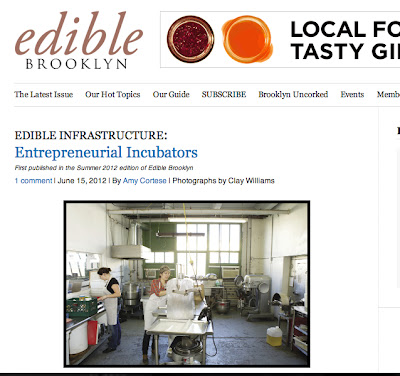
 Edible Brooklyn's picture of a production kitchen at Hana

Alan:  Is the incubator commercial kitchen here to stay? 

Michael:  We have good tenancy here now; I believe there is strong demand for incubator resources now, given the number of people who want to be entrepreneurs.  I’ve actually been looking at opening another location in the Bronx. 

Alan:  What’s next for you with Hana Enterprises?

Michael:  I want to attract bread bakers.  I see a need for a “central oven,” like when people years ago made their own dough and brought it to the baker to bake.  Except this could be for multiple artisan bread manufacturers, not just individuals. I would like that to be a center point where one day I can open my facilities to also become markets where the incubator clients can easily sell their products.

Alan: That sounds great Michael We’re really impressed with what you’ve done here.

Tuesday, April 2, 2013

Interview with Miriam Rieder of Taste by Spellbound – Dessert Studio


Interview with Miriam Rieder
Taste by Spellbound – Dessert Studio
Avon, CT


By Kathryn Gordon and Jessie Riley 


Kathryn:   Hi Miriam!  I met you in one of my macaron classes, but how did you get started in your business?

Miriam:  My first business venture was at 10 years of age, decorating cakes after taking a summer class at the local Parks & Recreational department in my area.  My mother enrolled me when she got divorced.  And now we bake together!


Photo:  HartfordMag.com
Jessie:  Did you always want to bake?

Miriam:  I grew up with a love of food but it didn't become a passion until a few years back. 

Kathryn:   How did you find the location for your bakery?  And how many square feet is the bakery? 


Miriam:  I found the location through a family friend.  The bakery is 1,100 square feet. I had saved up quite a bit over the past two years and was able to fund most of it.  We had to take out a small loan as well for our business financing.  I've been very blessed.

Jessie:   You’re very young; when you started the business a year ago, you were 20!  What else is it that differentiates you from other businesses? 
 
Miriam:  The quality of my food and atmosphere of the bakery. 

Kathryn:  You seem to have a pretty clear vision for a general patisserie, from your personal look (retro hairdo), vintage apron collection, business card and photos on Facebook.   The bakery evokes Alice in Wonderland.   How did you develop your vision?

Miriam:   I've loved fairy tales for quite awhile and with my baking business being named Taste by Spellbound, I was able to piggyback off my first business venture (fashion headbands), Spellbound.

Jessie: How many employees do you have?   

Miriam:  There are 2 part time employees who bake with me.  I don't even keep a running log of how much I work.  I just know it's A LOT.  I’m baking, running a business and teaching classes. 


 Jessie: How do you see the role of social media for your business?

Miriam:   It's huge.  Facebook is a major media outlet for the business. I post photos and update my fans daily with what we have in the bakery and fun pictures of all the projects we're working on.  But I also have close to 1,000 followers on Twitter as well.  [Follow Miriam @MiriamHope on Twitter].  And although Twitter is an amazing outlet I think Facebook is still “where it's at.”  You can connect and interact with customers and friends so easily.


Jessie:  Who takes your photographs?

Miriam:  I take all the photos for Facebook and Twitter; I love taking pictures of food.  

Kathryn:  What is the link to the Z100 radio station, and how often do you make an appearance?

Miriam:  I sent Elvis Duran on the Morning Show some of my truffles!  Now I've made 5-6 appearances on Elvis Duran over the past 2 years.

Jessie:  Do you see a spike in internet orders after you're on the radio?

Miriam:  Sometimes yes, sometimes no. But regardless, it refreshes people’s memory about me and the business.

Kathryn:   What advice would you give other entrepreneurs regarding self promotion?

Miriam:   Don't be afraid to put yourself out there and sell yourself. Just keep at it and the fan base will grow.


Want to Learn More About Our Expanded Services? Visit  Us At Food Start Up Help


Sunday, June 3, 2012

Time to Expand?

Time to Expand?


An interview with Master Boulanger Philippe Soulard by Kathryn Gordon
Name of Business:  La Maison du Pain
        At location # 1 of 3, Angers France
        http://lamaisondupain-angers.fr/

Kathryn:  So Philippe, I’ve been coming here to visit with you at la Maison du Pain for the annual ICE culinary course to learn about artisan, levain leavened breads since 2006. Now I hear that you have opened 2 additional locations of la Maison du Pain?


Original location of La Maison du Pain in Angers

Philippe:   Our city, Angers, underwent an extensive 3-year construction project for a tramway.  After the first few years, the construction really impacted our business.   Nobody could really drive through the city so demand for our product was limited to neighborhood walk-in customers, so we were forced to expand to other locations. 

Kathryn:  Do you offer the same products in the new locations as you do in the original location, or does it vary by neighborhood? 

Philippe:   We sell the exact same products at each location.  We make 65 different bread products from 29 different doughs!   The second location is a second production bakery that I took over – and the third location is retail only.  Honestly, the third location is in a better neighborhood (people with more income) than the second location, and the demand is steadier there across the product lines.

Kathryn:   If you took over a production bakery, how did that go, if you changed a pre-existing product line over to your products and renamed everything to the name of your business, “la Maison du Pain?”

Philippe:   The transition was a bit rough at first.  For example, there was a type of bread people wanted, but I didn’t want to make it so I didn’t bake it.  We lost some people at first but since then, demand has stabilized.  We’ve been open in that second bakery location about 6 months.  The third location has only been open a few months. 

Wife Catherine, who manages the retail operation

Kathryn:  I know you use a lot of organic (biologique) flours – but you’ve also said your customer base is not affluent enough to solely demand organic products because of the higher retail price.  What are your food costs? 

Note:  the stone-ground, water-driven mill that produced Philippe’s organic flours is Moulin de Sarre, www.moulin-de-sarre.fr and is very interesting to visit if you are in the Loire Valley. 

Philippe:  My food costs are about 25%.  I don’t look at it on a product-by-product basis, but overall that’s what it is.

Kathryn:   You and your wife Catherine live here with your family above the original location, and she manages the retail shop.  And that has allowed you to tell if your staff are starting work on time at 4 am!  How on earth are you managing the other full scale production bakery you are now operating?  


Couche, new, 10 years old and 50 years old

Philippe:   I only need 4 hours of sleep a night.  It was difficult at first, because I needed to find very good people, including a very friendly retail staff.  In France, firing employees is difficult so you have to be very careful making sure you are selecting the right employee…   For the production staff, I moved over one of my sous chefs as the manager of the second production bakery.  I kept the bakers who had been employed by the bakery I acquired and brought each of them to work here with my staff to learn my product.  Gradually everyone was trained.    

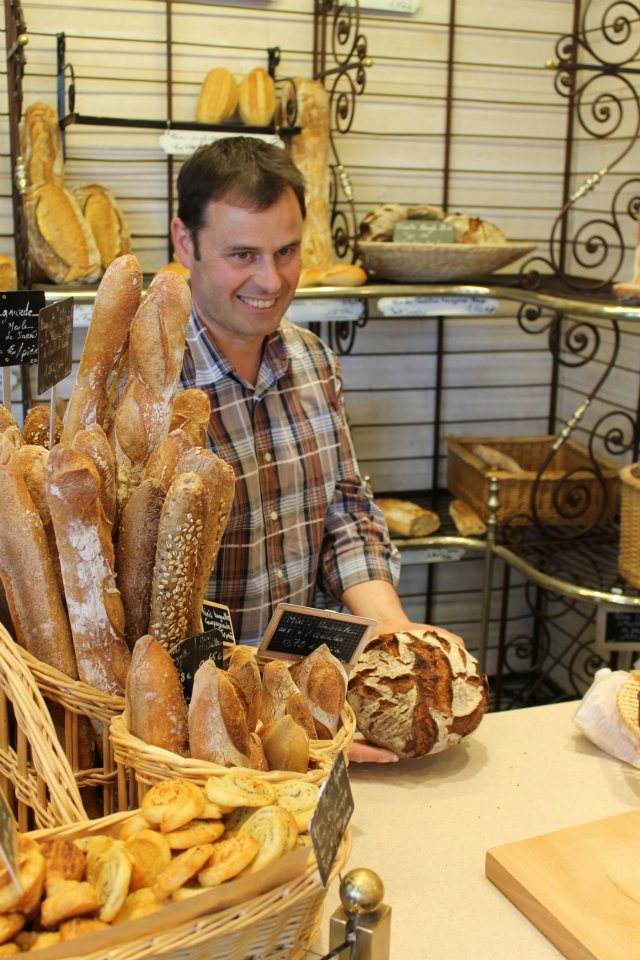
Philippe in the store with some of his breads

Kathryn:  Your specialty is levain leavened breads – you seem to try to only use commercial yeast minimally, like for the rich yeast products (brioche, croissants) and for one of your 10 different baguettes.

(Philippe produces one cheaper, machine driven, yeast risen baguette for the older generation who lived through WW II and don’t care for the more chic/nutritious/high end breads with whole wheat, rye and grains.  That customer base likes the commercial white flour).

Kathryn:  Are the breads truly the same in each location, because I’ve tried making “your” breads in NYC and they work.  They’re great breads, but they’re not exactly what you make here in Angers.  And your 3 locations of la Maison du Pain are all within the Angers city-limits (or about 5 miles apart).

Philippe:  It’s true.  I try to have the same product line at all 3 locations but at the second bakery location, even using the same brands of flour, and having trained the staff myself, – some of the breads come out a little different.

A crusty wheat levain loaf

Kathryn:  And within the same city, the available city, water in the bread doughs is presumably the same!  For instance, if I try to make your formula using water from NYC (which has chlorine, fluoride and who knows what else), I should expect a different result!   Of course – you have a bit more of the “wild yeasts” available here in a location that has been a boulangerie for decades, than some people have at their US bakeries (or their homes).  

Kathryn:  How much commercial yeast to you use in your dough formulas?

Philippe:  There’s nothing wrong with using a bit of commercial yeast and I use the fresh variety in some of my doughs. 

If you strictly use levains for all your doughs, the levains and the doughs take up more space in your bakery.  You need space for longer fermentation of the levain and space for longer fermentation of the pates (doughs).  And space equals money.

Kathryn:  How did you finance your expansion?

Philippe:  In France, you can get a bank loan for 7 years if you file an application that includes your resume.

After 7 years of operating a business, I would have to pay a higher tax to the government than for the first 7 years.

It is more economically viable in France to re-mortgage and expand a business, or at least try to expand until you retire and sell your business (where you would then pay less taxes because you are in retirement).

I was able to get the bank loan for the expansion because we were successful with the first location.


Boulanger Philippe showing how his ovens work in a class; we visit Philippe for an artisan bread lesson in the annual ICE Cuisine Course in France (www.moulinbregeoncuisinecourses.com)

Kathryn:  And you have quite a resume!  You even come from a family of bakers.

Philippe:   My father was a baker, and my brothers are bakers.   I went to school for several years for bread, and then I travelled around the country to boulangeries working for a flour company.  I had to help work at different bakeries every day.  I really learned a lot about bread doughs, in different environments, and what I wanted to produce for my own line of levain leavened bread.

Kathryn:  With all this expansion, you need a website!   You have all this cute stuff in the retail shop:  aprons with your logo, bread baskets with your logo, reuseable shopping bags… 

Philippe:  Yes, we know!  As we’ve been discussing for years.   It will be live this summer. 

Kathryn:  OK Philippe, thank you!  And we’ll follow-up again with you in a few months when the website is live.

Couche, used for proofing shaped breads, 50 years old 


Want to Learn More About Our Services? Our Primary Website is


Monday, May 7, 2012

Owning A Retail Bakery (The Story 5 Years In)

-->
Meet the Entrepreneur
An in depth interview (with future follow up) to expore the lessons learned by others like you in the baking business

Owning a retail bakery
Interview with Marie Jackson by Jeff Yoskowitz and Kathryn Gordon
Name of business: The Flaky Tart, Atlantic Highlands, NJ


“Coming out of a dark place…  Nobody knows what they’re in for, before they get a grip on balancing the financial viability of a business with creative freedom…” - Marie

Jeff:  Let’s start at the beginning.  What did you do before you opened the bakery?  You took a huge risk because you’d never worked in a bakery before, right?

Marie:  I have a degree in accounting, and worked for a year as a public accountant after college.  I thought it would be a good entry point for a future business but I also knew accounting was not for me.  I did some small jobs while going to culinary school at the New York Restaurant School. 

I got married and my husband’s family ran a snack shop at a seasonal beach club.  I asked if I could fix it up, make it profitable, and bake there for 2 years.  That gig wound up being 16 years long!   I was able to sell wedding cakes, make decorated cookies, do some catering, etc., out of that commercial space.  I found that I loved the summer business the best.  I had a staff to interact with, and customers to talk to.   I decided not to have an isolated wedding cake type studio, but to go into an actual retail bakery and have a community around my baking.

                                                         In The Flaky Tart Office

Jeff:  How did you take the leap to open up this business?

Marie:  Six years into baking out of the snack shop I looked at renting a space, but it fell through.   I was really relieved because I realized I wasn’t ready for my own establishment.  I didn’t have enough experience and my marriage was new, so it was time to put opening a business on the back burner. 

Ideally, I wanted to work in France, but by then I had three babies. Suddenly, the bakery in town where I lived went out of business.  It was the perfect scenario with the kids’ school being right across the street. I could work at the bakery and be able to pick up the kids right after school.  My husband and I looked at each other and decided this unique of an opportunity would never happen again so we decided to give it a try. We’ll be finishing up five years here at The Flaky Tart this fall and finally I will be able to work only when they’re in school.  That took three years longer than planned.

Kathryn:  How many employees do you have now?

Marie:  In the back (kitchen) we have five, including an intern and excluding me! In the front there are two working at any given time, so it’s three full time employees and four part-timers.  I have a nice mix of people with different ages, including high school kids.

                                                  A view of the bakery production area

Jeff:  When you started this business, did you have any partners?  Financial backers?

Marie:  I was so alone…  And it is so not the way to do it!

Jeff:  So now that you’re five years into it, what were the biggest surprises? Obstacles? Regrets?

Marie:   I was exhausted!  I am a marathon runner and a workhorse animal but the problem was that the bakery required me doing that every single day, and it beat me down physically, mentally and emotionally.  The lesson learned is that there are several equally mandatory jobs.  There’s the baking job versus managing “the vision,” and for one person that magnitude is not sustainable -there must be a partner or delegation- or money to hire more employees.

Jeff:  Was that the biggest challenge you’ve faced? 

Marie:  Well, sales have not been a challenge because I received good free publicity.  The back-of-the-house numbers crunching, even with an accounting degree, is the most difficult process to keep up with.  Employees are challenging in that if you want to hire professionals who are loyal and stay with you, they must be paid a livable wage. 

Kathryn:  What kind of rates do you pay your employees, is it more salary or hourly?

Marie:  I pay my “adult” (pastry chef) employees who have mortgage payments on a salary versus the younger ones who are paid on an hourly basis.  I actually think I would rather pay everyone hourly, so that sales and payroll expenses would stay more in line (busy time = more sales and more hours).

Jeff:  You’ve been in business several years now. How has your current menu changed and why do you think you needed to evolve it that way?

Marie:  Initially I was guided by a book (Growing Your Business) which believes a successful business has to be an extension of you. I want to make products that taste fantastic, and I don’t want to copy any French or American style bakery so we pretty much have a blend here of what I think I bake well.  Over time we’ve added some items but tried to keep it simple. 

Editor’s Note:  About 2 years ago, Marie talked with chefs Jeff Yoskowitz, Kathryn Gordon and Ciril Hitz about the direction her bakery was taking.  At that point she was managing the business and continuing to do the majority of the baking, or at least attempting to do both…

Marie, continued:  After talking with Jeff, Kathryn and Ciril I gave my staff some autonomy and mobility, and delegated the baking and they’ve introduced new product that is selling!  They’re now the growth engine and that’s awesome! I didn’t expect that.  

Jeff:  How have food costs been working out for the new items?

Marie:  Well, it’s happening too quickly and we don’t have a handle on it. This is the same issue that got us into trouble in the beginning. There’s a system out there on how to train you staff on costs, which we are actively looking into.

Jeff:  What direction is your menu currently going?

Marie:  We’re looking to balance the “cool things” with the low labor cost/low food costs and right now it’s the opposite.   We need to figure out what our staples are and what sells whatever the weather, whatever the traffic.  

One of my staff updates our Facebook page daily with our lunch menu and specials, posting all new items -- I have nothing to do with it and it works really well to help generate new customers.

Jeff:  When you opened you replaced an existing bakery. What were your customer’s reactions?

Marie:  Initially some customers had some expectations about heavily-decorated themed cakes (from the former bakery) and a few people were discombobulated, but I had changed the look of the bakery so much that they were excited about the new place and our new products.

Jeff:  Do you know who your customer base is?

Marie:  They’re everyone!  We get people from all different types of socio economic and geographic areas. The local press awards I’ve received bring people in, as well. I have done every charity that’s ever walked in the door. I am co-participating in my first set of advertisements now, but that’s actually for our town, not specific to my own business.

Kathryn:  You wanted to quit. What turned your feelings about the bakery around for you?  You’ve said it was around the time when I introduced you to Ciril Hitz.

Marie:  One really important turning point was when I was at my rock bottom (when we met), and I even went to NYC for a holistic doctor to try to get vitamins. I was so exasperated I believed that could help me – but he told me about a book called The E Myth.  The line that I live by now is “if you want to be a baker, get a job in a bakery.  If you own a bakery, you have a new job, you are a business owner and if you don’t do your job, you will fail.”  It changed everything when I read that.

What really helped was a friend, Mike, who told me, you are a success!  I had already achieved my goal which was to bake a great product.  Mike told me I needed a new goal, and that was to be a financial success – that I didn’t have to sacrifice the integrity of my product to make money.  I just had to adjust my thinking.

Ciril Hitz and I were talking about making money, and that it doesn’t just come if you make great stuff.  Ciril told me that I was doing this as a hobby if the bakery was not making money.  Wouldn’t I rather hang out with my kids instead? 

I think a lot of people fail because they just want to do their art, and the trick is you have to do both; the art and the business.  My heart and soul is in this bakery, but I have to find the balance to let my employees do their jobs and for me to manage better. 

Jeff:  You have to learn how to let go, and that’s a big step

Marie:  I think I had to hit rock bottom.  It was a process to realize I could not go on any more, but that I was unable to let go until I could acknowledge that I’m a control freak and my never-give-up-mentality had lead me into a hole.  I had to let go completely then I could decide to take back what I wanted to…

Jeff:  So you’ve told me you back the project completely alone. Any words of advice?

Marie:  I think it’s kind of good that I don’t have the pressure of a loan, either from a bank or an investor.

Jeff:  Although an investor would have forced you to have more control over a business plan and the numbers…

Marie:  I never put it all together with my vision for beautiful, delicious, accessible, high quality food. It’s hard to forecast reality and write that business plan. I achieved the goals I had had, and now I’m ready for a different goal and to succeed financially in that. 

Jeff:  What investment are you happiest about having made over the years?

Marie:  I hired a graphics designer for my packaging early on, and that was an important investment to have an iconic logo.  I paid a couple of thousand dollars and it was worth every penny to have a focus, a by-line and an identifiable image. 

Kathryn:  Do you think your space here is adequate for your production?

Marie:  I’ve learned that “if you have more room, you just spread out more.” I like the bakery to look busy.

Jeff: How’s the rent?

Marie: My rent’s low.  About $1700 per month (with a 3, 5 and 5 year lease renewal).

Jeff:  What were the rent increases for each of those periods?

Marie:  Generally there are small increases per year, up to 5%.  We haven’t received any in the last two years because I did a lot of renovations and the economy has been bad, so the landlord gets a lot of croissants from me!!!

Jeff: Marie, thank you so much for your time. Next time we visit we’ll check up on how you are doing and hopefully you will have some more success stories for us!

Marie: Thanks!
                                      Marie with the signature logo for The Flaky Tart
                                      __________________________________________
Want to Learn More About Our Services?  Our primary website is www.foodstartuphelp.com

Friday, April 20, 2012

Bringing a Packaged Product to Market

Meet the Entrepreneur
An in depth interview (with future follow up) to explore the lessons learned by others like you in the baking business

Interview with Jenny McCoy and Diana Lovett by Jeff Yoskowitz and Kathryn Gordon
Name of business: Cisse


This is the initial interview in a series with the partners of Cisse, a partnership to bring “guilt free” free trade cocoa products to the consumer


Jeff:  First of all, what is everyone’s involvement?  Are you partners in Cisse? 
Jenny:  Diana and I are co-founders of Cisse and will be managing the day-to-day operations.
Diana:  I am the fundraising, financing and business operations side of the business for long-term-growth planning, and meeting supply chain logistics.  For example, all the cocoa is ethically sourced, and I will manage those relationships because I have worked in developing countries, non-profit enterprises and socially responsible businesses before. 
Jenny:  My background is baking and pastry.  I went to culinary school after high school and worked in restaurants for over 10 years.  Last summer, I met Diana and we decided to work together on the brand development for Cisse. 
Diana:  Jenny is responsible for product development, and will do any required business writing given her interest and background in writing cookbooks.  Jenny will represent the brand from the food side and be the name and face of the brand. For this to be a successful partnership, we refined our roles right from the beginning and established a business partnership through legal papers (regarding vesting, likenesses, profit sharing, etc.).  After this formal structure, our roles fall into natural patterns given our particular backgrounds and passions. 

Jeff:  Did you use attorneys?
Diana:  In the beginning we used a friend-of-a-friend as a third party for negotiating the general terms, and then turned the specifics over to an attorney. 

Jeff:  Are you self-financing?
Jenny:  Diana has provided the seed capital and we are now evaluating financing options, raising additional capital. 

Jeff:  Was there a particular defining moment for deciding to go into business for yourself?
Diana:  You can purchase product at a fair price in communities to help support community development and I felt that the price premium for doing it ethically and through fair trade practices was do-able.  This business became viable when I met Jenny. 
Jenny:   A few years before meeting Diana, I was thinking about the bigger picture and what would challenge me beyond restaurant work. I wanted to transfer my work as a pastry chef into other projects.   An editor at Epicurious introduced us and our initial conversation led to a request to be involved more as a partner than a consultant.   It helped me that I was talking to my very business savvy, conservative father and he said:  “If this is something you want to do, this sounds like a cool opportunity.” That did it for me, and I took the leap and said okay to Diana.

Jeff:  So you have a partnership, and everyone knows their roles. What happened next?
Diana:  The phasing of the sales channel dictates every other aspect of how we structure the business.  Our focus is on long term growth and ultimate profitability.  We felt the grocery sales channel was the best fit, since it has a national presence.  That initial decision focused our energy. We knew that Whole Foods was the biggest player and they were the company we needed to approach.
 
Jenny:  We set up a deadline to race towards – the Whole Foods “Round 9” category review deadline (which includes items such as cocoa mixes and baking mixes).   We started to work on product development, which meant me getting into a kitchen while we were simultaneously working with a graphic designer and doing market analysis.  We wanted something that would be accessible and generate repeat sales, nothing too crazy like lavender brownie mixes (which might only appeal to a group of pastry chefs!). 
Diana:  Jenny’s teaching background and cookbook writing project helped a lot with being able to focus on consumer needs.  Given our business model, the core ingredient had to be ethically sourced, so we went to the Dominican Republic to meet with the farmers. 

Kathryn:  How did you decide who to work with on this project?
Diana: At first it was cold calling for brokers, suppliers, graphic designers, co-packers, etc. We started with a list of questions and put the answers in a spreadsheet, to make an analysis and an apples-to-apples comparison possible.   Otherwise we’d still be floating in a sea-of-data! 
Jenny:  We found some good fits through people who were also starting off and were very enthusiastic about working with us, like our graphic designer.  
Diana:  The costs for the initial development of our website, logo and packaging ranged from $2,500 to $140,000.  It was definitely interesting to see that price range! 

Jeff:  So designing packaging is always interesting -- tell me about it.
Jenny:  It’s amazing, learning that a small box of cocoa mix, or a baking mix, has to have so much stuff on it!  It was overwhelming.  Bar codes, our story, what shade of blue? There was the hurdle of getting through the actual design and then finding printers to generate a small run for samples.  30 pieces per SKU is very expensive!  We had to call and convince people we were legit and going to grow as a company to get it done without a run of 15,000. 
Diana:  The consumer design interface took so much time – we didn’t know what would be required.  Each step is so interrelated.  Jenny had to finalize the recipes before the nutritional panel could be generated, for example.  It takes a lot of manpower to get all those deliverables in.


Kathryn:   What’s the timing of when you approached Whole Foods to market?
Jenny:  We had some counsel from an insider’s perspective in the form of a meeting with the Whole Foods Round 9 product manager about a month before submitting the product.  They originally asked if we could be up on the shelves in 1-2 months, but it will about 5-6 months when we think we’ll be ready (aiming for this September).
  
Jeff: Can you tell us a bit about the product development?
Jenny:  I learnt that my 100% is too much -- that the product I initially designed was “too rich” or “too fancy” for what the ultimate product is going to be on the shelf. My 100% would have cost too much to produce for a variety of reasons.  Maybe my original method to make that brownie was too involved for basic steps in consumer baking.  Maybe I would have preferred a richer chocolate percentage, but it wouldn’t appeal to a wide range of people.  I had to adjust my recipe approach from a 3-star restaurant experience, to make a product I still feel good about, and see how people react to the products that can be made from these mixes.

Kathryn:  Did you put together any formal tasting panels or focus groups for the product development phase? 
Jenny:  It was mostly informal through families and friends.  One interesting experiment was when I baked all available brownie mixes and all available cocoa mixes and had everyone react to it versus mine. That feedback was instrumental in reformulating my recipes.

Jeff:  If you were able to achieve the quality you’re looking for, how about the price point?
Diana:  Well, that’s a production volume question.  To get gourmet ingredients with a socially responsible angle to them is the overall challenge – but luckily we’re now within their range for the price point. 

Editors:  We’ll track the progress of Cisse putting their products on the shelves of Whole Foods and report back to you!


Short bios on Jenny and Diana:

Diana Lovett, Co-Founder: While completing a Fullbright program and a year of volunteer work at an orphanage in South Africa, Diana became committed to a lifelong pursuit in creating social justice. Her experiences at such an early age inspired her to pursue a B.A. in African Studies at Yale, followed by an M.A. in Internal Development Studies from the University of Cambridge.

Her many experiences include being a legislative analyst for Governor Bill Richardson and being Director of Regional and International Campaigns for singer Alicia Key’s charitable outlet “Keep A Child Alive.”

As culmination of all her experiences, Diana co-founded Cisse, a small business that combines her dedication to social responsibility by aiding small growers of cocoa to ear living wages, and her love of chocolate.

Jenny McCoy, Co-Founder: Jenny held positions in a variety of Chicago’s top restaurants including Charlie Trotter’s, Blackbird, Gordon and Bittersweet Bakery.

After traveling to various countries to broaden her culinary vocabulary, Jenny completed a B.A. in Food Writing at DePaul University. She returned to the pastry kitchen where she would run three restaurant pastry departments for Emeril Lagasse.
Jenny has also worked in New York City as the opening pastry chef at Marc Forgione; for A Voce, where she oversaw pastry operations for both their Madison Square and Columbus Circle locations; and at celebrity Tom Colicchio’s flagship restaurant, Craft, where she helped earn its second three-star review from the New York Times.

Finally, Jenny won the 2011 Rising Star Pastry Chef Award; is the spokesperson for the Almond Board of California; and is working on her forthcoming dessert cookbook, to be published by Rizzoli in 2013.


Want to Learn More About Our Services? Our Primary Website is