Translate

Showing posts with label incubator kitchens. Show all posts

Monday, August 27, 2012

Getting Customized Solutions to Make Your Food Startup Prosper


Tell Us What You Need

Interview with Sho Islam
Rutgers Food Innovation Center
Interview by Jeff Yoskowitz, Jessie Riley and Kathryn Gordon


Jeff:  Hi Sho, can you tell us about the Rutgers Food Innovation Center here?  It seems like it is located in the middle of nowhere.

Sho:  We have been Bridgton since 2000, and are a Center of Rutgers University. This area in Southern Jersey is historically “the garden” of the “Garden State,” but agriculture and the economy in general has declined over the decades and we are here to increase the economic activity in the region, specifically as it related to food businesses.

We’ve had the incubator facility open for about 4 years.  We help with all aspects of starting and expanding a food business, from concept to commercialization.  We offer a unique incubator center where food establishments can come to get all the support they need to become successful, profit sustaining businesses.

We have 4 production bays, and can schedule up to 4 simultaneous production runs if necessary.  Our facility is USDA and FDA approved.


Jessie:  What kind of staff do you have here? 

Sho: We have marketing, business development, and regulatory specialists, a food technologist and production and plant operators on staff.  We also work with other organizations and companies on as-needed basis to meet the need of our clients. For example, clients may work with SBDC (Small Business Development Center) if they need help writing the business plan, or a private company/consultant for logo design; but we’d be there to guide the client through the process.   

Kathryn:  How do you charge for the consulting you do? 

Sho: We work on a cost recovery model and prices are customized for the need of the client.  Our business and technical mentoring rates are priced at $100 per hour (for smaller start ups) and $150 (for larger companies).  Our production facility rates vary by the room that is being utilized and the frequency of occupancy but rates vary from $750-$1250 per day.

Jessie:  How many people a year do you assist?

Sho: Typically we deal with about 250 unique companies/individuals inquiring per year to determine how they can be best assisted by us. To date we’ve assisted over 1400 companies/individuals.

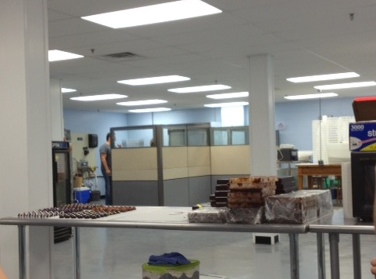
One of the 4 production bays at the Center, with walk in blast freezers, walk in freezers and refrigerators behind

Kathryn:  Is there a typical length of time companies are here working with you?

Sho:  No. The length of time varies based on many variables; some of our clients work with us on very specific short-term projects (food sensory for example),  some have been working with us for years and others have moved on to co-packers or built their own facility (Schar USA for example). 

Jeff:  What’s the main advantage you provide a business to work here with you versus at another incubator?

Sho:  We are a one-stop shop. We work to make sure you have the best odds of success when the product is launched.  We work with companies on whatever it is they need in terms of marketing, business mentoring, product development and/or production assistance. 

Jessie:  If I owned a burgeoning company who wanted to work with you, how would I go about it?

Sho:  You would contact the Center, fill out our questionnaire and then we would have an initial consultation. Afterwards, we would develop a customized proposal that meets your needs. 

Jeff:  What’s your success rate of mentoring companies, and how do you define success?

Sho:  Of the companies we’ve assisted to commercialize products, greater than 85% of our clients are still in business. 

Jessie:  This is an amazing facility, thank you so much for the tour!


Want to Learn More About Our Services? Visit us and learn more at

Friday, August 10, 2012

How to Successfully Run an Incubator Kitchen

Interview with the owners of Hesperides Kitchens & Bakeries in Hawthorne, NJ
Lisa and Albert VanDenBerg with Kathryn Gordon and Jeff Yoskowitz


Kathryn:  Hi Lisa, Hi Albert. I met you here a few months ago when I came to help with the production of one of your clients.  I’ve spoken to several of your clients who say that the two of you are completely supportive of them and what they’re trying to do.

How long have you been in the commercial incubator kitchen business?

Albert:  It’s been about 2 ½ years.  This is my grandfather’s old feed & grain mill from the 1920’s, that has been split into 4 buildings.  Originally, there was a guy who rented some space here and built himself a kitchen for dipping oils.  After he left a cookie company moved in, but they wound up selling their business.  When I was trying to rent the kitchen space, a company called, Red Ribbon Pretzel was starting out and needed a small kitchen.  I just said, “come see what I’ve got!”  They decided that this space would work for them to start their business, and that’s how it all started, and Lisa and I got into the incubator business. 

Lisa:  I run an organic farm in NY State.  We also use some of the space here ourselves for a CSA (Community Supported Agriculture) and food co-op.  It allows us to sell our product, and to feature our incubator client products as well.  For example, CSA share participants can pre-order any one of our incubator client products for pick-up when they come here on Tuesdays for their fruit/vegetables.  We also have a CSA for cheese, other dairy products and coffee.   Some of our incubator kitchen clients use the vegetables and fruits from the farm.  We are trying to help these people make money – as the owners we want them to make money and succeed. 


Lisa VanDenBerg with product showcase in the CSA pickup space at Hesperides with incubator client products

Kathryn:  I love it!  You’re facilitating farm-to-table and supporting local artisanal food producers at the same time.  That’s brilliant.

Lisa:  We attended a NEOFA (Northeast Organic Farming Association) conference on incubator kitchens. That was very helpful to help us understand more about this business and get some tips from other farmers who have supported product incubation.

Albert:  For example, I build the walk-ins myself. NEOFA participants gave us tricks like how to rig up an air conditioner for the walk in and bypass needing an overhead compressor, We’re able to cool the walk in for a fraction of the typical set-up cost.

Jeff:  I’m not sure I understand that, but it sounds really useful to know! 
Can you tell us more about your facility and the mechanics of how you set everything up here?

Albert:  We have 11 kitchen spaces here, in an 8,500 square foot facility.  2 kitchens (one bakery, one culinary) are rented by the shift, and the others by monthly clients.  In total, we currently have about 40 customers. 

Lisa:  We find people through referrals on the internet, and the Rutgers incubator facility.   We have also had a client who “outgrew” our space, wasn’t ready for their own kitchen, and transitioned to Rutgers (which can support a higher level of manufacturing).  For example, to wholesale meat-based products you have to be in a USDA facility like Rutgers.

(Editor’s note: look for our upcoming interview at the Rutger’s incubator kitchen)

Kathryn:  How do you schedule clients for the shared commercial kitchens?

Albert:  We recently started to use Google calendar, and it’s working very well for us administratively and for the clients.   Freelancers can see the available time slots on the web, but only Lisa and I can actually schedule people to use the space.  Everybody who works here knows they have to be flexible to be able to keep their production costs down, and share the space.


Jeff:  How to you approve people to use your space?  What kind of requirements do you have, and what do people get for a base price? 

Lisa:  We require $250 a month minimum.  For that, they also get a storage rack (clients have to provide a cover and a lock), and storage in the shared fridge and/or freezer walk-ins.  Each kitchen has a standard set of equipment: burner, convection oven, reach in refrigerator, 20 Qt. Hobart and speed rack.  Clients provide their own small wares and sheet pans.  Everyone shares the 3-part sink dishwashing area, break-room and bathrooms.


Albert:  Clients are required to carry one million in product liability insurance, and have a Serv Safe food handler’s license to use the bakery kitchen.  To use the culinary kitchen, they have to have the Serv Safe manager’s certification. 

Jeff:  You don’t require a security deposit or pre-payment?  What happens if someone breaks a 20 Qt. mixer or something on their shift? 

Albert:  That’s actually only happened once, and the shift worker’s boss helped to pay for the repair.   We’re trusting in that sense.

Kathryn:  Can you talk about the food handler’s licensing and how you work with the local health inspector?  If there’s an inspection, and you have 40 clients, how does that process work?

Albert:  I also have a food handler’s license.  Everyone has to follow my procedure manual.  I have to be the leader because if the health inspector comes in, whatever they find could shut me (and the entire Hesperides incubator facility) completely down.

Lisa:  We walk through the kitchens daily.  One of us, or our son, is here every day.  We throw away any ingredients that have expired.  We throw out any food that’s not covered.  If someone left dirty dishes in the shared 3-part sink, we just throw them away.  We have to – it’s our liability.


View within Hesperides from Shelly Goldenberg’s Chelique chocolate production area 
                                                              

Jeff:  When you build out a new kitchen, how do you get your equipment?  And is it both gas and electric here?

Albert:  I buy used equipment on Craig’s list, and it works out well because I can work on the maintenance.  I try to buy new convection ovens.   The ovens are gas, and the 6-burner stove in the commercial kitchen is gas – everything else runs on electric.   Our total utility bill is 5% gas.  In the summer, the air conditioning to keep the kitchens cool is the highest cost. 

 
Kathryn:  And how does it work if a particular monthly client needs a special piece of equipment?  For example, you have people here making ice cream.

Lisa:  We used our electrician who knows the building to run the lines, and the client who needs that equipment pays the electrical installation cost. 

Kathryn:  And you’ll charge them a higher electric fee too?

Albert:  Yes but it isn’t on a separate meter, so I work with each individual client on their pricing.  For monthly clients, each pricing arrangement differs anyway, based on their kitchen size.

Jeff:  What’s the turnover like of clients?  How are you marketing to find clients for the kitchen spaces? 

Lisa:  At this point, we get 10-15 inquiries per week.  Everyone thinks they can do this! So the spaces pretty much fill themselves.  We have a majority on a monthly plan, which requires us to train people less (we train new people on how to use the equipment, and we have to “watch” new people more in terms of the cleanliness standards, etc.)

Albert:  We have less turnover than you’d think.  Some clients have been with us from the beginning.

It’s a co-operative here so everyone has to get along.  I will turn people away if the product doesn’t really fit in.   We have gotten rid of people if they don’t clean up, or play the radio too loud.

Jeff:  You’ve seen a tremendous volume of new start-up food businesses walk through these doors.  What are the most common mistakes people make?

Albert:  Everyone thinks they want to rent their “own space,” not realizing that at least 50% of what’s required is outside, selling and working on websites/marketing etc.    Baking is not 100% of your time, so a shared space can be a perfectly viable option.  Sales and marketing needs as much attention as baking. 

Lisa:  People who were formerly home cooks do not realize the amount of production that they can make in 2 hours in a convection oven with a large mixer.
 
Albert:  I’ve seen people really not know what they’re doing in terms of pretty standard kitchen equipment, even ones who have graduated from culinary schools.  I read the manuals (for the Hobart and the convection ovens).  I know how time and temperature is affected by convection cooking – and I never worked in a kitchen!

On the positive side, the most amazing thing is that the clients help each other:  how to work a piece of equipment, where to source ingredients, or how to package a product.


Lisa:  We want our clients to be able to just focus on their cooking.  There are no hidden costs from working here – each client knows ahead of time exactly what each month’s production will cost in terms of rent/overhead/utilities.   We even take care of scheduling for the pest control, dumpster pickups and cleaning grease traps.  Clients clean their own kitchen spaces daily, but we also have a weekly cleaning service for the floors. 

Jeff:  Is there anything you’ve learned over the years that you wish you hadn’t had to deal with?

Albert:   It was a learning curve about certification and the “black market” demand.  One of our clients would need a copy of their certificate to be able to sell at a farmer’s market, but then it would somehow get copied and be given to their friends (who were not legal clients and not producing their products in an authorized, commercial kitchen).  Those people would unfortunately represent themselves as working here, and that created a liability issue for us. 


Now we have changed the certification copying policy so that we will only fax directly to whoever officially needs it at the farmers market, etc. and the certificate for our approved clients is only for a specific business name, and for a specific length of time.

Kathryn:  Thanks Albert and Lisa!  It’s been very informative talking with you.   And the next time I come over here, I’m going to bring a cooler and buy some of the local artisan cheeses you offer!


Want to Learn More About Our Services? Visit us and learn more at

Saturday, June 30, 2012

Managing Your Time


Time Management Challenge

Interview with Marisa Iapicco
Chef/Owner of Semisweet
By Chef Kathryn Gordon


Kathryn:  Hi Marisa, so I met you a month ago here at the Hesperides Kitchens when I noticed your beautiful, decorated sugar cookies!  How did you get into doing this style of cookie with royal icing?


Marisa:  I started doing custom cakes as soon as people found out I had graduated from pastry school (Institute of Culinary Education/ICE in 2008).  I worked at a bakery in PA, and then my friends asked me to do holiday cookies that year.  This business grew from that demand.  I later moved to NJ, formed an LLC and found the incubator kitchen here in Hawthorne.  I still do small custom cakes and some cupcakes but my main business is decorated cookies.

Kathryn:  How long have you been here at Hesperides and how much time do you spend here a week?

Marisa:  I’ve been baking and decorating at Hesperides incubator for a year. Typically I am here in the bakery 4 days a week, 6-18 hours a day and the rest of the time I’m doing paperwork in my office and home.  I currently live 45 minutes away and that’s too far, so I’m moving soon to be 10 minutes away, so I can pop in to make dough when I need to, or package up cookies that have finished the drying process.

Kathryn:  When you sell your cookies, what kind of packaging do you use?

Marisa:  I am in the process right now of changing it, but I offer a clear top gift box with the cookies in shredded paper for the standard decorated cookies.  ‘Minis’ are packaged in clear plastic cylinders.  For custom cookies, which tend to be hand-delivered, my clients typically want them presented on a platter or an individually wrapped party favor.  I have tried heat sealing each cookie but I don’t feel it looks quite right so I put the cookies in a craft box, and seal the box.   It also works better to ship them that way.


 Kathryn:  I heard that you tried selling in a local mall but now you’re not there anymore.  Can you tell us about that process and decision?

Marisa:  There was a local mall that was (supposedly) trying to promote local businesses.  They offered a 3 month trial for a cart and in exchange I paid a percentage of my sales to the mall.  After that, a monthly rent would have been established based on my sales record.  I brought cookies and cupcakes over from the kitchen, and used my phone for credit card transactions. 


The cart had limited electricity, so I couldn’t put anything in a refrigerated case.  The problem was the mall placed my cart inan area where the sun came in through the roof.  Per the mall’s rules, I wasn’t allowed to put up an umbrella.  The cupcake icing got soft, and some of the royal icing colors faded on the cookies.  It became clear that my product and the location in the mall were not a good “fit.”  There were just too many obstacles and restrictions.   I didn’t have the “clout” as a trial customer to argue with the mall but it did give me a heads-up that maybe I wouldn’t have wanted to sign a long term lease with them if they were going to be so difficult to work with.


Kathryn:  Besides the mall-selling experiment, how do you market your product?

Marisa:  I have a website, and people find me on the internet.  The biggest part of my business is through word of mouth.  My business has grown exponentially without me spending anything on advertising.  My biggest customers are moms and brides-to-be who order cookies for engagement parties, bridal showers, baby showers, and bachelorette parties. I also do some corporate orders.

Kathryn:  I see various sizes and shapes of cookies here in your kitchen. How do you organize your product offering and pricing?

Marisa:  I have 2 lines.  The first is a standard collection with holiday and seasonal specials.  I offer vanilla, chocolate, orange-almond and gluten free for those cookies, and they are iced with royal icing but these are the standard shapes and colors.  I have different sizes, including ‘minis.’  I can work on the standard cookies pretty quickly because I know the designs.  My second line is custom cookies.  I have lots of different cookie cutters, and I work with a client to develop what they want.  Based on the detail required and the number of royal icing colors on each cookie, the price for custom cookies increases ($5.50 is typical per cookie).  It takes more time to design each of the icing effects for a custom cookie.

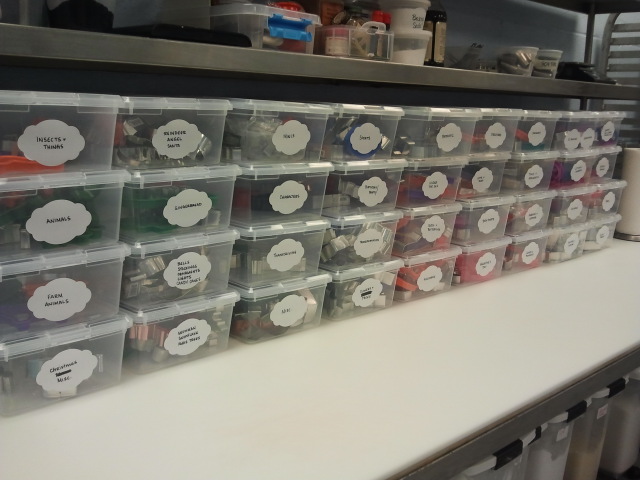
Organization of Semisweet’s cookie cutters
On top of the cookie prices, I charge for delivery.  Within NYC, I charge a $30 fee to cover the cost of tolls and gas.  I also deliver within 3 counties of NJ.  Other than that, people can either pay for a situational delivery charge, or pay to ship the cookies.  They do ship fine.  

Kathryn:  Marisa, are you doing all your own deliveries?

Marisa:  At the moment, I am the only one working on the whole process.  I’m making the dough, rolling it out, baking, and icing both the standard and custom lines.  I am trying to persuade my husband to help, because he’s very good at the artistic side, but he’s in graduate school.  My mother helps a lot – sometimes she assists me in the kitchen, and she’ll organize or clean, or help with the finances.

Kathryn:  That’s not sustainable. Either you’ll burn out, and/or you’ll max out the income you can earn off of your business.  I’ve watched you, here in the kitchen working and I see your labor time for these hand-piped cookies is incredible. Can’t we get you some externs from ICE to help you?  

Marisa:  I need to have standard production days where I do the same thing each day before I can bring in an extern.  Right now I don’t have a standard production schedule and each week varies.

Kathryn:  I think someone could be trained by you to make your doughs, roll them out to the thickness you need and cut and bake them.  Maybe even after you’ve piped them, an extern could come in and pack the dried cookies for you and get them ready for delivery or shipping?  You could retain the “control” of the icing, at least for the custom cookies?

Marisa:  Luckily, to date I’ve been able to do everything myself.  It has meant that I haven’t had to worry about paying someone else.  The labor time to make these cookies is enormous.  Between rolling the dough, and the drying time for the icing to set, it takes 18 hours per cookie order over the course of the week.

Now I’m pretty much maxed out, doing everything myself.  I do need to restructure my time, have better production organization, and have a standard schedule in order to take on more work. 

My busy season starts in the fall with “back to school,” birthday parties and then all the string of holidays.  I am planning to restructure this summer, tackle my time management, and take on some externs and be ready to gear up.

I’m starting with having someone re-work the website.  I’ve also been starting to target new distribution channels for my high end, custom work in an effort to gain more corporate clients.  But you’re right; I have to be able to remove myself from doing all of the production to also be able to tackle these goals.


Kathryn:  Okay Marisa, thank you for your time!  Why don’t we talk again after the summer, when you’re geared up for a new phase of growth?  We’ll be able to review your new operating procedures!  


Want to Learn More About Our Services? Our Primary Website is