Translate

Showing posts with label square. Show all posts

Monday, July 30, 2012

Words From a Food Truck Pioneer


Interview with Jerome Chang
Chef/Owner Cathcart & Reddy (Formerly Dessert Truck and DT Works)
6 Clinton Street, Lower East Side, NYC
By Kathryn Gordon

Kathryn:  Hi Jerome, it’s nice to meet you.  Tell me about how you started your business.

Jerome:  I’m an attorney who changed careers and went to FCI (French Culinary Institute) for their pastry program.  Then I got some fine dining experience in the industry for about 3-4 years.  At first, I thought I’d take the more traditional career path, like working to become the executive pastry chef of a hotel.  

Kathryn:  Why did you start off your entrepreneurial career with a desserts truck?

Jerome:  That story’s a little bit strange, and who knows, but it just sort of happened.   It seemed like a great idea, and I felt I was seasoned enough to pull it off well.

It was 2007. The time had come for the democratization of really good food.  Chefs were offering more casual dining options for really solid food other than white table cloth establishments.  At the time we were looking to get into business, there was a general movement to make really good food accessible. 

We were pretty much the first gourmet food truck out there.  If you look back at the old magazines (guides to NY), we’re in all of them when the NY food truck movement started.


Kathryn: Well, now you have a retail space. Was it always a dream to have a retail location? 

Jerome:  No, not really, especially as we didn’t have deep (financial) pockets and we still don’t.  Basically I’m a small business owner who commutes from where I live in Harlem to the Lower East Side because the rents were reasonable here.  I have one business partner, Suzanne.  I had a different partner in the beginning who left after the first year because he had never been in the hospitality business before and didn’t understand what the work entailed.

I met my current business partner, Suzanne, when I was working at Le Cirque. She had started in chocolate working with Jacques Torres.

Kathryn:  Okay, so you're both veterans then, from the Jacques Torres/Le Cirque world. That explains the bomboloni style doughnuts (“Brioche Doughnut Squares”) on your menu! 

Kathryn:  Why did you decide to transition to a set location and stop selling products off the truck?

Jerome:  Last winter, we determined it was time to retire the truck because it was on its last legs.  The whole truck aspect is a double-edged sword.

Kathryn:  Why?

Jerome:  It’s the logistics of it.  The city regulations (against parking in metered spots) don’t work in your favor and that was a negative.  There have been police crackdowns against food trucks and neighbors can complain, get you ticketed, fined and towed.  

We did use the truck to support corporate catering for film and TV, and that was a good revenue source. 

Kathryn:  When you had the truck, where did you park it at night after you closed up?  And before you had the retail and kitchen space where did you do your production?

Jerome:   Overnight the truck has to be in a Department of Health approved commissary, so it was parked in Brooklyn when we weren’t selling.    

I produced for the first couple of years in 2 different shared kitchens, beginning by working out of the kitchen of a catering company. 

Kathryn:  When I last visited, this location was called “DT Works” for “Dessert Truck Works,” and now you’ve changed your website, and some signage, to Cathcart & Reddy.  Why did you decide to change the business name again? 

Jerome:  Well, we had gotten rid of the truck and people just get confused!  They would mix us up with other trucks.  We helped create a (mobile food) movement in NYC. There were other trucks with dessert, but we were the only ones focused on desserts.

We no want to reach a wider more traditional audience. Having the truck name didn’t help and they were skeptical.

Kathryn:  You’re located on the Lower East Side and you want a more traditional audience?

Jerome:  To be able to grow, we need to reach a wider customer base.   It’s been hard here to build up a business during the day.  The most traffic on this street is at night so we’d like to attract more people throughout the day. 


Kathryn:  Do you have any regrets with the path your business has taken?

Jerome:  I have definitely made mistakes.  I think the hardest thing is to make the transition from fine dining, where we live in a bubble and all think like foodies.

As chefs, we fantasize technique and exotic techniques too much, and that doesn’t help you “run a business.”  95% of your customers don’t care about that.  You have to learn how to produce things that are easy to understand. It’s not about “pretty.”

Kathryn:  Do you think that you were prepared for what you’ve had to do?

Jerome:  I understand food costs and I did a business plan.  I think most new businesses that fail don’t make it because the owners don’t understand what they’re getting into, are not adequately prepared, and do not understand what operating their business truly costs them. First and foremost, they do not understand their food costs or how to determine it.

Note:  Food Start Up Help consulting services can assist you with determining your food costs, vis-à-vis industry standards.  Please visit www.foodstartuphelp.com

Kathryn:  I love that you’re using your iPad for your POS (Point of Sales) system.

Jerome:  Yes, it’s very easy to use.  A few months ago SQUARE came around aggressively marketing merchants, and it’s free.  I created a custom menu and can add new line item additions (products) as needed.

Note:  Square is a free system that allows you to swipe credit cards via your iPhone and turns your iPad into a cash register.  You can research whether it could help your new business at www.squareup.com.  Food Start Up Help chefs Kathryn, Jeff and Jessie like that it has in-depth analytics and reports that will help you understand your sales patterns.


Kathryn:  What would you like most to happen next for your renamed business, Cathcart and Reddy? 

Jerome:  We’d like to attract more customers.  We need more people to venture this far over on the Lower East Side.  It’s a 10 minute walk here from the closest subway, but we like the space, the rent is cheaper than other places we found, and Clinton Street is a food destination street. 

Kathryn: Thanks Jerome!


Want to Learn More About Our Services? Visit us and learn more at

Saturday, June 30, 2012

Managing Your Time


Time Management Challenge

Interview with Marisa Iapicco
Chef/Owner of Semisweet
By Chef Kathryn Gordon


Kathryn:  Hi Marisa, so I met you a month ago here at the Hesperides Kitchens when I noticed your beautiful, decorated sugar cookies!  How did you get into doing this style of cookie with royal icing?


Marisa:  I started doing custom cakes as soon as people found out I had graduated from pastry school (Institute of Culinary Education/ICE in 2008).  I worked at a bakery in PA, and then my friends asked me to do holiday cookies that year.  This business grew from that demand.  I later moved to NJ, formed an LLC and found the incubator kitchen here in Hawthorne.  I still do small custom cakes and some cupcakes but my main business is decorated cookies.

Kathryn:  How long have you been here at Hesperides and how much time do you spend here a week?

Marisa:  I’ve been baking and decorating at Hesperides incubator for a year. Typically I am here in the bakery 4 days a week, 6-18 hours a day and the rest of the time I’m doing paperwork in my office and home.  I currently live 45 minutes away and that’s too far, so I’m moving soon to be 10 minutes away, so I can pop in to make dough when I need to, or package up cookies that have finished the drying process.

Kathryn:  When you sell your cookies, what kind of packaging do you use?

Marisa:  I am in the process right now of changing it, but I offer a clear top gift box with the cookies in shredded paper for the standard decorated cookies.  ‘Minis’ are packaged in clear plastic cylinders.  For custom cookies, which tend to be hand-delivered, my clients typically want them presented on a platter or an individually wrapped party favor.  I have tried heat sealing each cookie but I don’t feel it looks quite right so I put the cookies in a craft box, and seal the box.   It also works better to ship them that way.


 Kathryn:  I heard that you tried selling in a local mall but now you’re not there anymore.  Can you tell us about that process and decision?

Marisa:  There was a local mall that was (supposedly) trying to promote local businesses.  They offered a 3 month trial for a cart and in exchange I paid a percentage of my sales to the mall.  After that, a monthly rent would have been established based on my sales record.  I brought cookies and cupcakes over from the kitchen, and used my phone for credit card transactions. 


The cart had limited electricity, so I couldn’t put anything in a refrigerated case.  The problem was the mall placed my cart inan area where the sun came in through the roof.  Per the mall’s rules, I wasn’t allowed to put up an umbrella.  The cupcake icing got soft, and some of the royal icing colors faded on the cookies.  It became clear that my product and the location in the mall were not a good “fit.”  There were just too many obstacles and restrictions.   I didn’t have the “clout” as a trial customer to argue with the mall but it did give me a heads-up that maybe I wouldn’t have wanted to sign a long term lease with them if they were going to be so difficult to work with.


Kathryn:  Besides the mall-selling experiment, how do you market your product?

Marisa:  I have a website, and people find me on the internet.  The biggest part of my business is through word of mouth.  My business has grown exponentially without me spending anything on advertising.  My biggest customers are moms and brides-to-be who order cookies for engagement parties, bridal showers, baby showers, and bachelorette parties. I also do some corporate orders.

Kathryn:  I see various sizes and shapes of cookies here in your kitchen. How do you organize your product offering and pricing?

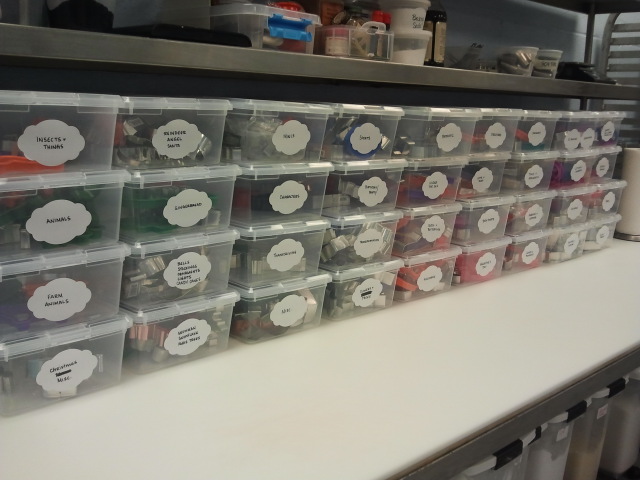
Marisa:  I have 2 lines.  The first is a standard collection with holiday and seasonal specials.  I offer vanilla, chocolate, orange-almond and gluten free for those cookies, and they are iced with royal icing but these are the standard shapes and colors.  I have different sizes, including ‘minis.’  I can work on the standard cookies pretty quickly because I know the designs.  My second line is custom cookies.  I have lots of different cookie cutters, and I work with a client to develop what they want.  Based on the detail required and the number of royal icing colors on each cookie, the price for custom cookies increases ($5.50 is typical per cookie).  It takes more time to design each of the icing effects for a custom cookie.

Organization of Semisweet’s cookie cutters
On top of the cookie prices, I charge for delivery.  Within NYC, I charge a $30 fee to cover the cost of tolls and gas.  I also deliver within 3 counties of NJ.  Other than that, people can either pay for a situational delivery charge, or pay to ship the cookies.  They do ship fine.  

Kathryn:  Marisa, are you doing all your own deliveries?

Marisa:  At the moment, I am the only one working on the whole process.  I’m making the dough, rolling it out, baking, and icing both the standard and custom lines.  I am trying to persuade my husband to help, because he’s very good at the artistic side, but he’s in graduate school.  My mother helps a lot – sometimes she assists me in the kitchen, and she’ll organize or clean, or help with the finances.

Kathryn:  That’s not sustainable. Either you’ll burn out, and/or you’ll max out the income you can earn off of your business.  I’ve watched you, here in the kitchen working and I see your labor time for these hand-piped cookies is incredible. Can’t we get you some externs from ICE to help you?  

Marisa:  I need to have standard production days where I do the same thing each day before I can bring in an extern.  Right now I don’t have a standard production schedule and each week varies.

Kathryn:  I think someone could be trained by you to make your doughs, roll them out to the thickness you need and cut and bake them.  Maybe even after you’ve piped them, an extern could come in and pack the dried cookies for you and get them ready for delivery or shipping?  You could retain the “control” of the icing, at least for the custom cookies?

Marisa:  Luckily, to date I’ve been able to do everything myself.  It has meant that I haven’t had to worry about paying someone else.  The labor time to make these cookies is enormous.  Between rolling the dough, and the drying time for the icing to set, it takes 18 hours per cookie order over the course of the week.

Now I’m pretty much maxed out, doing everything myself.  I do need to restructure my time, have better production organization, and have a standard schedule in order to take on more work. 

My busy season starts in the fall with “back to school,” birthday parties and then all the string of holidays.  I am planning to restructure this summer, tackle my time management, and take on some externs and be ready to gear up.

I’m starting with having someone re-work the website.  I’ve also been starting to target new distribution channels for my high end, custom work in an effort to gain more corporate clients.  But you’re right; I have to be able to remove myself from doing all of the production to also be able to tackle these goals.


Kathryn:  Okay Marisa, thank you for your time!  Why don’t we talk again after the summer, when you’re geared up for a new phase of growth?  We’ll be able to review your new operating procedures!  


Want to Learn More About Our Services? Our Primary Website is