 Everyone Needs Someone
to Call
Everyone Needs Someone
to Call
Interview with Enid
Hoffman, CPA
By Kathryn Gordon and Jessie
Riley
I know you are a partner in a company with 250 accountants
or so, so you’ve seen lots of food businesses over the years. Let’s try to formalize some of the great
recommendations you have for food start ups.
What’s the biggest accounting issue you’ve seen for start-up
bakeries, cake/chocolate specialists, etc?
Enid: The most constant question I’ve seen
over my 34 years in the accounting business is:
you need help, but are you going to pay this person as an employee or an
independent contractor? There are legal
and illegal ways to pay workers. The
legal way adds an average of 15% to your cost structure, and that is a huge
expense for a new company. By law, if
you hire an employee you have to pay workers’ compensation, disability, and you
have to match the employee’s Social Security contribution. If you pay the worker as an independent
contractor you do not have to pay this extra 15%, but this method of payment is
illegal if the person is working as an employee in your place of business.
Kathryn: Is the cost of processing an employee’s
payroll also an issue? Like costs an employer would have to pay to someone through
ADP?
Enid: No, that’s small potatoes, maybe $20 a month
per employee. And I would definitely
recommend someone with more than one employee to use a service for the payroll,
because a payroll service can and should impound the payroll taxes. If you utilize this service, the tax and
insurance liabilities are withdrawn from your bank account immediately. That guarantees the start up business will
actually have the money paid to the various government agencies when the debt
is due.
The business may not use a payroll service but still must
remit the money on a monthly or quarterly basis. Too many businesses think they will have the
funds available but then spend the money for other business needs. A new business cannot survive if they are not
able to pay their bills on time, and you don’t want to accrue penalties from
the government.
Jessie: Speaking of survival, I think new
businesses are also afraid of having to pay an accountant on a monthly basis and
what those accounting services will cost them.
Enid: Sole proprietorship income and expenses are
incorporated in a personal tax return.
If you have a good computerized general ledger such as Quickbooks, and
no payroll, the return should run $700-$800 if there is no employee payroll.
Kathryn: So you recommend people use
Quickbooks?
Enid: Some sort of accounting program should
be used daily or weekly to assess your cash flow. You could post entries into Quicken, but it
is less robust than Quickbooks. Either
will tie to your bank account, but Quickbooks will allow more long term
flexibility and growth with your company.
You still need an accountant to help you set up the books correctly,
conduct a review of the books and records every 3 months for the first year, then
semi annually thereafter.
In any business you must reconcile the books and the bank
statement which Quickbooks does as a byproduct
of the program. If you do not reconcile,
the books become unreliable because one does not know if all items have been
posted and therefore you may or may not be reporting more profit or not showing
the proper loss.
Kathryn: I gather you recommend people absolutely hire
an accountant.
Enid: A lot of food-oriented businesses are cash
businesses. One of the biggest mistakes
I’ve seen people repeat over the years is that if it’s a cash business – and
you either pay too many people in cash, and/or take out too much cash yourself
– you can’t justify to an auditor that you’re making enough money to justify
the expenses you’re claiming such as food costs or your personal living
expenses. For example, you need to take
money to live on, or your business will never be sustainable, and auditors know
that. You do not want to create a risk
of a longer, more extensive audit because your expenses, sales and labor costs
do not tie.
Let’s say you operate a 24-hour a day pizza business. If you claim expenses for vast quantities of
flour for your pizza dough, and you don’t show commensurate sales or payroll
for the workers, then a government auditor would clearly know you are hiding sales
and will conduct a tougher audit – and you could be facing criminal charges and
would lose more than the cost of hiring an accountant to provide advice in the
first place.
Jessie: I know several small food-related
businesses that don’t seem to handle everything exactly correctly, like
co-mingling personal and business funds or might have questionable practices paying
their employees…
Enid: If you are co-mingling funds into one
checkbook, the IRS or the state could audit all of your personal and business
transactions which can be a costly and tedious audit. If the business has a separate account, the
auditors will audit only the business account and will not review the personal
expenses.
It can also create a risk if an employee pays the staff
without a W-2 (generating the 15% additional overhead for the workers’
compensation, disability and matched Social Security). This can result in a penalty for the business. Another problem is if you pay the worker as an
independent contractor (also known as a 1099 worker) – unless the worker truly
is an independent contractor. And for independent
contractor status, the worker has to: a)
work for more than one employer doing this type of work, and b) “hang a shingle
out” advertising that you are in this type of business. For example, if you’re in the yellow pages as
a freelance chef, only then, whether you work 1 or 30 hours for a company, you
would get a 1099. Only if you are a
corporation, you will not get a 1099.
Jessie: So what should businesses be aware of that
might be a red flag for getting audited?
Enid: “Invisible employees.”
A red flag is raised as soon as a company has a pregnant “invisible employee” who
files for disability because she can’t stand in your bakery 12 hours a day.
Other examples are someone washing dishes, who is paid as a “invisible
employee”, gets hurt on broken glass and goes to the hospital thinking he/she
has worker’s compensation, or the work is cyclical and the “invisible employee”
files for unemployment in a down period after making seasonal chocolates.
There’s no record of the “invisible employee,” because the
business hired the worker as an independent contractor (1099) therefore the
company didn’t pay the required workers’ compensation, disability or match the
Social Security – and that’s a risk for opening an enormous can of worms. Worker’s
compensation alone can issue 5 years of financial penalties and close down a
business!
Kathryn: I know that at some times in the past that I’ve
been an “invisible employee.” I also
know I’ve worked for someone who never issued me a 1099. Where do these lines get legally drawn?
Enid: There’s something called “20 common law
questions” regarding having to issue a 1099 for someone who is truly working
for you. The question has to do with who
can generate the ultimate profit from a scenario. Someone is considered truly freelance and will
receive a 1099 if they are in business for themselves. Then this person is not
an employee.
For example, if I am hired to make a wedding cake and I hire
you to do the work for $300, you can make the profit/loss depending on the
ingredients and time it takes you. This
person is an independent contractor. If I
ask you to come to my bakery and bake a wedding cake and I give you $30 per
hour and supply the ingredients, you are an employee, as the bakery is going to
make the potential profit or loss.
Kathryn: What’s the threshold someone has to
earn from one company to get a 1099?
Enid: If a company pays someone more than $600 in a
calendar year, they should issue a 1099.
Not all businesses do, but the burden is on the taxpayer as the taxpayer
must report all income whether the taxpayer received a W-2 or 1099. An employer can get a $50 penalty – but it is
rarely issued, so it’s a risk some businesses are willing to take. (By the way, if an independent contractor did
not receive a 1099 and they feel that they should get one, they can report the
business to the IRS via a complaint form you can download on the IRS website –
and that’s a better way to get action than just making a phone call to the
IRS).
Jessie: How often should I be contacting my
accountant to make sure my business is doing everything the correct way?
Enid: As an accountant, I accept calls all the
time. Every business needs someone they
can just call. I truly enjoy helping new
businesses establish themselves – what could be more rewarding? Eventually though, someone has to realize
that time equals money for professionals, and you might be sent a bill if you
continuously ask questions during the year.
Kathryn: So you might get a bill if you’re calling
your accountant 5 times a day, I guess?
Enid: People ask questions
all the time. It comes with the
territory, and I like sharing my expertise.
I’ve always liked helping young businesses, and have found that ones
owned by women especially need pushing.
I like doing it and it has become my niche, with over 70% of my client
base being women business owners.
Kathryn: Do you ever make field calls and visit
your clients?
Enid: It can actually be more cost effective to
visit a business at least once so you have a better understanding of what the
client is talking about, but on a routine basis for a single proprietor it
probably makes more economic sense for them to come into the accountant’s
office.
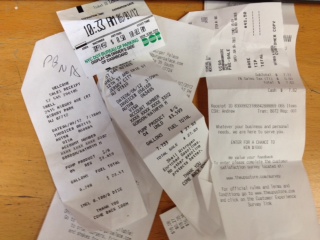
Hint from Chef Kathryn: Always enter your receipts on a timely basis into your accounting software, and scan them. After a period of time, most check register receipts fade. I've seen one (failing) small business not file their taxes for a long time, because they knew they wouldn't owe anything because their expenses far outweighed their receipts. Eventually garbage bags full of 5-year old, illegible receipts were brought to the accountant... Not a great business procedure.
Want to Learn More About Our Services? Our Primary Website is

 Jessie: Kathy, you
have a pretty big space here! How did
you get started with your bakery business and find this particular location?
Jessie: Kathy, you
have a pretty big space here! How did
you get started with your bakery business and find this particular location? Kathryn: Can you tell me more about your relationship
with Yale?
Kathryn: Can you tell me more about your relationship
with Yale?

 Kathryn: We came here today to offer a hands-on
macaron baking class. I know you already
have regular baking classes, and host birthday parties; are you planning to
expand the school part of your business?
Kathryn: We came here today to offer a hands-on
macaron baking class. I know you already
have regular baking classes, and host birthday parties; are you planning to
expand the school part of your business?


